
Google has quietly rolled out a new feature in its search results interface – a carousel labelled “Places sites”, designed to highlight curated local recommendations. If that sounds like just another update, think again. This change directly rewards local content publishers, travel blogs, and SEO-aware city guides that structure their content correctly.
And among the first to benefit? For example, in the travel sector, DMOs like Visit Bucharest are now featured alongside platforms such as TripAdvisor, Facebook Local, and Restaurant Guru.
What Are “Places Sites” in Google?
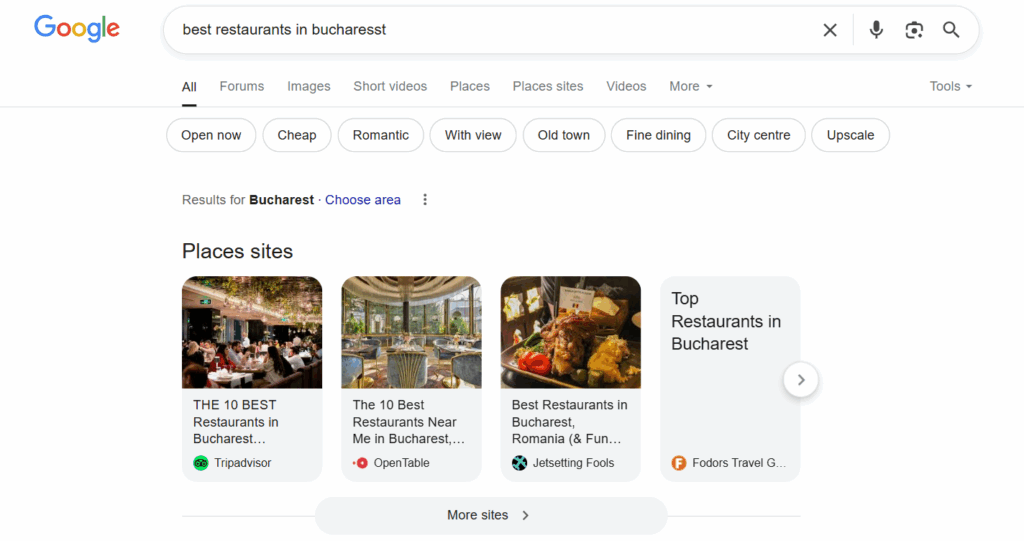
The “Places sites” carousel appears in local-intent searches such as:
- best restaurants in Bucharest
- things to do in Lisbon
- rooftop bars in Budapest
Rather than showing only map packs or review snippets, Google is now highlighting trusted third-party websites that present human-curated lists. Each card links directly to a content-rich list, like “Top 10 Italian Restaurants” or “Best Attractions in Bucharest.”
Featured platforms currently include:
- Tripadvisor
- Facebook Local
- Restaurant Guru
- Petit Futé
- Time Out
- TheFork
- Visit Bucharest
This isn’t an ad space. It’s Google elevating real content that helps people make informed decisions about where to go.
Why Google Is Doing This
The change is part of Google’s broader shift toward an intent-driven search approach. Users don’t just want business addresses – they want answers, experiences, and comparisons.
This move aligns perfectly with Google’s emphasis on E-E-A-T (Experience, Expertise, Authoritativeness, Trustworthiness) and supports its transition from a search engine to a decision engine.
It’s no longer about who exists on a map. It’s about who can explain what matters — and why.
How Visit Bucharest Got Featured
Visit Bucharest didn’t pay for placement. It earned it by creating:
- SEO-optimised, structured content
- Genuine “Top 10” lists that solve real user intent
- Internal content hubs around local themes (gardens, rooftops, bars, events)
- Clean design, mobile-first architecture, and fast page speeds
- Enhanced schema markup (
Breadcrumb,Article,ItemList)
By combining technical SEO with location-based editorial storytelling, Visit Bucharest became the only Romania-based site featured in Places Sites at the time of this writing.
How You Can Appear in “Places Sites”
If you publish tourism or local content, this new section could be your breakthrough — but only if you follow the right structure.
Step 1: Publish human-first, data-enhanced top lists.
Create clear guides: “Best places to eat,” “Top 10 rooftops,” “Hidden gems in…”
Step 2: Use structured data.
Add ItemList schema with each entry as a ListItem. Include name, URL, and position.
Step 3: Implement supporting schema.
Use Article, TouristAttraction, Place, and BreadcrumbList schema across relevant pages.
Step 4: Own your niche.
Don’t write about everything. Build deep topical relevance in one destination or theme.
Step 5: Monitor your Search Console.
Track impressions, clicks, and structured data validation. Use Discover and Rich Results filters.
Why This Changes Local SEO
Google’s new “Places sites” feature gives content creators a unique edge over listing-only businesses.
It shifts the power from physical presence (Google Maps) to digital authority (structured content). That means:
- City blogs can compete with global platforms
- Travel publishers can bypass Maps entirely
- Local businesses need content partners more than ever
For agencies like TUYA Digital, this presents a golden opportunity to help clients leapfrog traditional SEO tactics by establishing themselves as local authorities in their niche.
Final Thoughts
Google’s “Places sites” feature isn’t a one-off test. It’s a signal of what’s next: a SERP built around authentic experiences, structured content, and expert curation.
The inclusion of Visit Bucharest proves that independent local publishers can now compete head-to-head with global platforms, if their content is structured, optimised, and built for users, not just rankings.
If you want your content to appear there too, start by thinking like a local expert. Then structure it like a machine-readable authority.
Because in 2025, it’s not about just showing up.
It’s about showing up well-structured.