

For years, Google’s homepage represented functional minimalism. A blank screen, a logo and a search box. In its early days, Google deliberately differentiated itself from portal-style engines such as Yahoo, whose homepages were filled with news blocks, finance widgets and curated links. Google’s simplicity was positioning. We are not a portal. We are search.
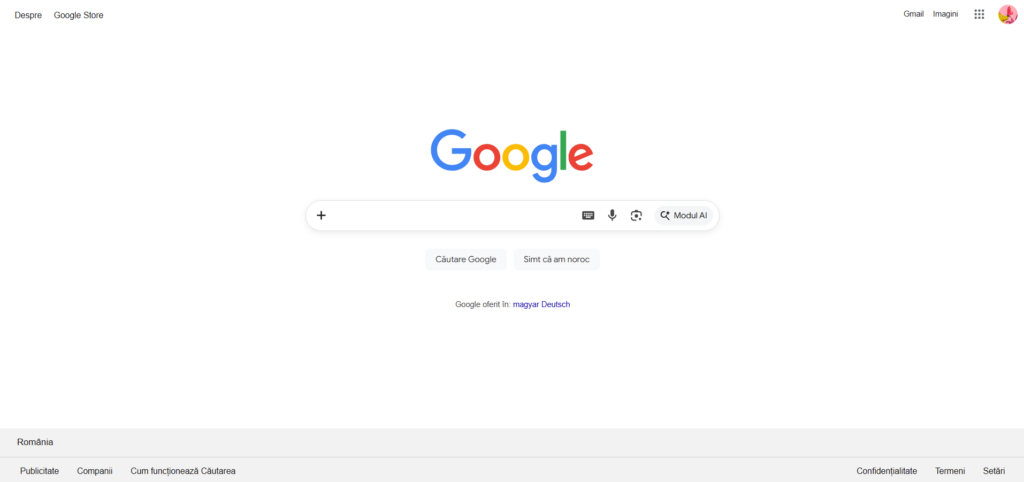
That distinction is no longer absolute.
Selected users across multiple markets are now seeing a homepage that integrates AI functionality directly into the search bar while also surfacing personalised content modules and Discover-style news panels beneath it. The blank page is becoming dynamic.
This is not a visual experiment. It is a shift in the search model.
Google’s Algorithm Update in February was about that.
From Query Engine to Discovery Layer
Historically, search began with articulated intent. A user typed a keyword. Google matched it. Results were ranked. Clicks followed.
The new homepage changes the starting point.
Users can now encounter curated content before typing anything. Personalised article cards and topic recommendations appear based on behavioural signals. AI Mode allows complex, multi-layered queries to be handled conversationally. Multimodal interaction is positioned as a natural behaviour rather than a secondary tool.
Discovery can now precede intent.
Search is no longer a strictly linear process. It is becoming layered. Passive exposure, AI-assisted synthesis and traditional ranking-based retrieval now coexist within the same interface.
That structural change has consequences.
The February Algorithm Update as Infrastructure
February’s algorithm update was widely discussed in terms of volatility and AI refinements. However, viewed through the lens of the homepage evolution, its direction becomes clearer.
The update strengthened how Google interprets intent, evaluates entity authority and integrates generative responses more deeply into the search experience. The homepage shift is the visible layer of that underlying recalibration.
Three dynamics stand out.
- Personalisation has greater influence on what is surfaced.
- Semantic understanding of entities is increasingly central.
- AI-generated summaries are more tightly integrated into user journeys.
The homepage is not changing in isolation. It reflects the algorithm’s expanded role as a mediator of attention rather than simply an index of pages.
Convergence of Search, Discover and AI
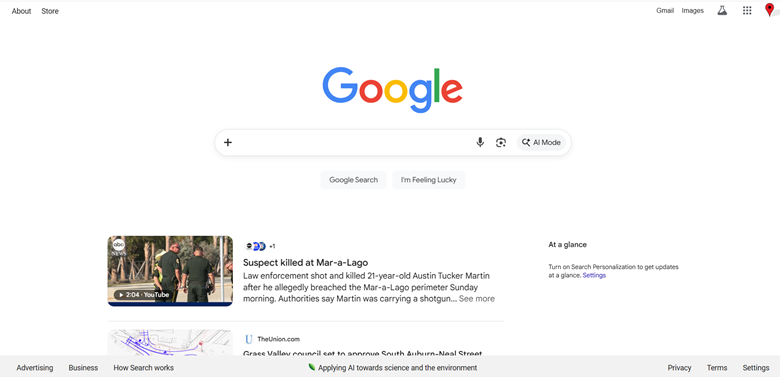
Three systems that previously operated in parallel are converging.
- Traditional SEO-driven search.
- Behaviour-driven Google Discover.
- Entity-based generative AI responses.
On the new homepage, these systems intersect.
Visibility is therefore no longer defined solely by ranking position. Inclusion within AI-generated responses, eligibility for Discover-style modules and clarity of entity authority now influence exposure.
SEO remains foundational. GEO becomes strategically essential.
Implications for SEO
Technical integrity, crawlability, structured data and topical relevance remain non-negotiable. That has not changed.
What has changed is how informational queries are mediated. When AI systems synthesise answers directly on the results page, click-through behaviour shifts. Impressions may grow while sessions stabilise or decline.
Content that merely restates widely available information is more likely to be condensed into summaries. Differentiated insight, original analysis and strong topical depth increase the likelihood of inclusion and citation.
Discover-style surfacing introduces additional variability. Engagement signals, recency and topical clustering influence whether content appears in personalised modules. Authority is assessed behaviourally as well as structurally. So the famous E-E-A-T still stands, partially.
Ranking still matters, but it is no longer the only lever.
The GEO Dimension
Generative Engine Optimisation responds to the reality that AI systems interpret content semantically rather than purely lexically.
To surface within AI-driven environments, brands must demonstrate clear entity definition across platforms and structured data, strong author and expertise signals, coherent topical clustering and internal linking that reinforces semantic relationships.
AI systems reward coherence and clarity.
If a brand’s signals are fragmented, inclusion probability decreases even if individual pages rank well.
Visibility within generative interfaces becomes an architectural challenge as much as a content one.
The Return of the Old School Homepage, Reinvented
There is a strategic irony in this transformation.
Google once distanced itself from portal-style search engines. Yahoo’s dense homepage represented clutter.

Google’s blank page represented focus.
Today, Google is adopting an old-school structure, powered not by manual curation but by personalisation and AI.
The difference lies in intelligence, not density.
The homepage is evolving into a predictive attention surface. It shapes exposure before users consciously define their queries. Some searches may never be typed if the system anticipates them.
The Strategic Outlook
The homepage evolution reflects a broader direction. Search is becoming a unified attention ecosystem where AI synthesis, personalised discovery and traditional ranking operate simultaneously.
For brands and publishers, adaptation requires recalibration:
- Content must move beyond generic summaries.
- Entity authority must be structurally reinforced.
- Discover visibility must be treated as a strategic channel.
- Measurement frameworks must account for impression growth without proportional click growth.
- AI citation visibility should enter performance reporting.
The minimal homepage once symbolised retrieval.
The adaptive homepage signals mediation.
Google is no longer only organising information. It is organising exposure.
For SEO & GEO agencies operating at the intersection of SEO and GEO, this is not incremental change. It is a shift in where optimisation begins.