
Social media is changing again, and this time the shift is not only about formats, short videos, creators or algorithms. It is about trust.
For years, users have accepted the same basic deal: free platforms in exchange for attention, behavioural data and algorithmic influence. We scroll, react, post and share inside systems we do not fully understand. We rarely know why a certain post appears in our feed, why another disappears, why one opinion becomes viral, or why a false claim can travel faster than a verified fact.
This is the context in which eYou enters the market.
eYou is a European social network built around a different promise: social media that is more transparent, more verifiable and more controlled by the user. Its core positioning is clear. The platform wants to combine social interaction with real-time fact-checking, transparent algorithms, user-controlled feeds and a stronger European approach to data and digital responsibility.
That alone makes it worth watching. But for creators, entrepreneurs, journalists, brands, experts, agencies and early adopters, the more important question is simpler: should you sign up and start posting now?
The answer is yes, especially if you understand how early social platforms create opportunity.
What is eYou?
eYou is a new European social media platform designed as an alternative to the dominant global networks. It was publicly launched in Bucharest in May 2026 after gathering around 50,000 registered users during its waitlist phase. The project has been presented as a response to the growing fatigue around misinformation, opaque algorithms, manipulation, echo chambers and the feeling that major platforms no longer serve users first.
Its main features are built around three ideas.
The first is real-time fact-checking. eYou allows posts to be checked inside the platform, helping users assess claims without leaving the conversation.
The second is algorithmic transparency. Instead of treating the feed as a hidden black box, eYou promotes the idea that users should understand and influence what they see.
The third is European data sovereignty. The platform positions itself as a European alternative in a market largely dominated by American and Chinese technology companies.
This does not mean eYou is guaranteed to become the next major social network. No early platform can promise that. But it does mean the project is entering the market with a timely and relevant angle.
Why eYou arrives at the right moment
The timing matters.
Users are tired of feeds that feel manipulative. Creators are tired of publishing into algorithms they cannot predict. Brands are tired of paying more for less organic reach. Journalists and experts are tired of seeing misinformation travel faster than corrections. Younger audiences are increasingly sceptical of legacy platforms, but they still need spaces for identity, conversation and discovery.
At the same time, Europe has a clear strategic problem: it depends heavily on non-European social media infrastructure. Public conversation, political debate, cultural visibility, creator monetisation and brand communication are largely mediated by platforms built outside the European digital model.
eYou is trying to enter that gap.
Its promise is not just “another app”. Its promise is a different kind of social contract between platform and user: less passive scrolling, more visible context, more user control, more accountability around information.
That is why early participation matters. If the platform grows, the first serious users will have an advantage. If it remains niche, those users will still gain a useful experimental channel at a time when social media strategy needs diversification.
Why you should sign up early
The first reason to sign up now is identity ownership.
On every social platform, early usernames, handles and brand names become valuable. If you are a founder, consultant, creator, journalist, public figure, agency, media project, NGO, local business or expert, securing your name early is a basic defensive move. It costs little, but it protects your digital identity from being taken by someone else.
The second reason is visibility.
New platforms usually have less content saturation. That means early posts can travel further because the content supply is still limited. On mature platforms, you compete with millions of creators, paid campaigns, legacy accounts and algorithmic fatigue. On a new network, good content has a better chance of being noticed because the platform is still shaping its culture.
The third reason is learning.
Every platform develops its own language. LinkedIn has one rhythm. TikTok has another. X has another. Instagram has another. If eYou grows, the people who understand its tone, formats, audience behaviours and engagement patterns early will be ahead of those who arrive later and try to reverse-engineer the platform after it is already crowded.
The fourth reason is credibility.
A platform built around trust and verification could reward a different type of creator. Not the loudest voice. Not the most aggressive poster. Not necessarily the most viral account. But the person or brand that can publish useful, well-structured, credible content consistently.
That is a meaningful opportunity for experts, educators, analysts, consultants, media brands, agencies and serious creators.
Why brands should not ignore eYou

For brands, the mistake would be to wait until eYou becomes “big enough”.
That is how brands usually lose first-mover advantage. They wait for proof, then enter late, then complain that organic reach is weak and paid media is expensive.
The smarter approach is different: enter early, test lightly, learn the environment and build a presence before the platform becomes crowded.
A brand does not need to abandon LinkedIn, Instagram, TikTok, Facebook or X to test eYou. This is not an either-or decision. It is a diversification move.
The right question is not “Will eYou replace the big platforms?” The right question is “Can eYou become a relevant trust-based channel for audiences who are tired of the current social media model?”
For some brands, the answer could be yes.
This is especially relevant for sectors where credibility matters: technology, education, public affairs, health communication, sustainability, finance, journalism, legal services, civic initiatives, B2B consulting, tourism, local communities and European projects.
If your brand depends on trust, clarity and expertise, eYou is worth testing.
What should you post on eYou?
Do not start by reposting random content from other platforms. That is the lowest-effort approach, and it rarely builds a strong account.
Start with content that fits the platform’s promise.
Post short expert observations. Explain complex topics clearly. Share verified context. React to current issues without exaggeration. Build threads around useful ideas. Ask better questions. Add sources when relevant. Use the platform not only to broadcast, but to show how you think.
For personal brands, eYou could become a good place to publish informed opinions before they become mainstream discussions elsewhere.
For companies, it could be used to build authority through concise educational posts, founder perspectives, product explanations, industry commentary and transparent communication.
For media projects, it could become a distribution and credibility channel.
For agencies, it is a space to test how trust-based social content performs compared with attention-based social content.
The first content rule is simple: do not chase noise. Build signal.
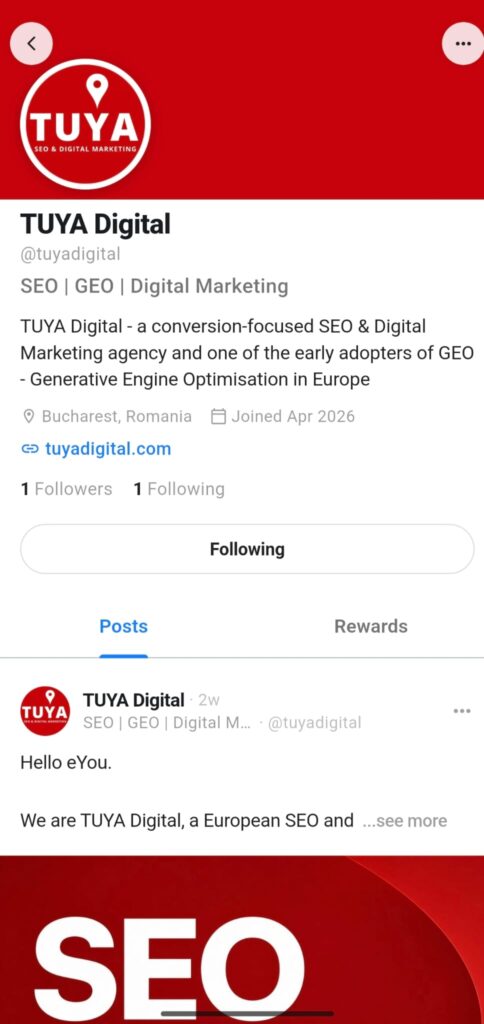
Opinion from Social Media Expert: Laura D., TUYA Digital

From a social media strategy perspective, eYou should not be judged only by its current size. It should be judged by its strategic direction.
Laura D., social media expert at TUYA Digital, sees eYou as part of a wider shift in how users evaluate platforms:
“People no longer want only entertainment from social media. They want control, context and a reason to trust what they see. That does not mean every user will leave the major platforms, but it does mean there is space for new networks built around credibility. For creators and brands, the smart move is to enter early, secure the identity, observe the culture and start publishing useful content before the platform becomes saturated.”
Her view is pragmatic. eYou should not be treated as a guaranteed replacement for existing platforms, but as an early-stage opportunity with strategic potential.
“The biggest mistake brands make with new platforms is waiting until everyone else is already there. By that point, the organic advantage is gone. On eYou, the opportunity is not just to post. The opportunity is to help define what quality content looks like on a trust-first social network.”
That is the correct mindset: cautious, but active.
The creator opportunity
For creators, eYou could be particularly interesting because the platform’s positioning may favour substance over pure performance.
On many mature platforms, creators are trained to optimise for reaction: shock, speed, outrage, humour, repetition, trend participation. That model works, but it also creates exhaustion. Many creators now feel forced to produce content for algorithms rather than for people.
A trust-oriented network could encourage a different creative behaviour.
It could reward creators who explain, verify, contextualise and build meaningful discussion. It could also attract users who are tired of low-quality viral content and want a more deliberate feed.
That is not guaranteed. Every platform depends on its community. But early users influence that community. If high-quality creators arrive early, they can help shape the tone.
This is another reason to start now.
The European angle matters
The European positioning is not just branding. It is strategically important.
Europe has strong regulatory frameworks, robust privacy expectations, and a growing interest in digital sovereignty, but it has not produced many mainstream social platforms capable of competing culturally with global incumbents. eYou is entering that conversation with a clear message: Europe should not only regulate social media; it should also build alternatives.
That message will resonate with users, institutions, founders, journalists, policy professionals and brands that already care about the future of the digital public space.
For European companies, this creates an additional reason to explore the platform. Being present early on a European social network is not only a marketing experiment. It can also be a positioning move.
Should you trust eYou completely from day one?
No platform should be trusted blindly from day one.
eYou is still new. Its fact-checking system will need to prove accuracy at scale. Its moderation model will need to handle conflict, abuse, coordinated manipulation and politically sensitive content. Its privacy promise will need to remain consistent as the platform grows. Its algorithmic transparency will need to be understandable not only in theory, but in everyday user experience.
These are serious challenges.
But they are also the right challenges to tackle.
The point is not that eYou has already solved social media. The point is that it is trying to solve the right problems: misinformation, opaque recommendation systems, loss of user control, declining trust and platform fatigue.
That makes it relevant.
Why posting now is better than waiting
If eYou fails, the cost of testing it early is low.
If you ignore it early, the cost could be high.
That is the strategic calculation.
Early posting gives you several advantages: name ownership, audience discovery, content testing, platform learning, organic visibility and positioning as an early participant in a European social media experiment.
You do not need to overinvest. You do not need to move your whole content strategy there. You do not need to pretend it is already bigger than it is.
You simply need to create an account, secure your handle, complete your profile and start posting useful content consistently.
That is enough to begin.
Final perspective: eYou is worth taking seriously
eYou arrive at a moment when social media feels increasingly broken for many users. People still want connection, discovery and conversation, but they are more aware of manipulation, misinformation and algorithmic pressure than ever before.
A platform built around trust, transparency and user control has a real reason to exist.
Will eYou become a major social network? That depends on execution, adoption, moderation, product quality and community behaviour. But the strategic opportunity is clear.
For creators, it is a chance to build early visibility.
For brands, it is a chance to test a trust-first communication channel.
For experts, it is a chance to publish in a space that may reward credibility.
For European users, it is a chance to support a different model of social media.
So yes: sign up, secure your handle and start posting now.
Not because eYou is guaranteed to win.
Because if it does win, the people who understood it early will be in the strongest position.