
Google has officially finished rolling out AI Mode across Europe, a significant step that redefines how people search, discover, and interact with information online. Powered by the new Gemini 2.5 model, AI Mode doesn’t just answer questions – it reasons, plans, and interacts like a genuine digital assistant. For consumers, this means smarter, more natural searches. For businesses and SEO experts, it signals a fundamental shift toward Generative Engine Optimisation (GEO), optimising content for AI-driven search results.
What Google AI Mode Really Is

AI Mode, accessible by clicking the right button in the Google search bar, is the evolution of Google Search into a conversational, multimodal experience.
Instead of typing and browsing through lists of blue links, users can now talk to Google, show it images, and receive highly reasoned, contextual responses. It combines text, visuals, and follow-up dialogue into a seamless information journey.
Think of it as a blend of Google Search, ChatGPT, and Google Lens, all integrated directly into your everyday search experience. The underlying Gemini 2.5 model enables AI Mode to handle multi-step reasoning tasks, such as travel planning, product comparisons, or creative research, which previously required multiple searches.
What Changes for Consumers
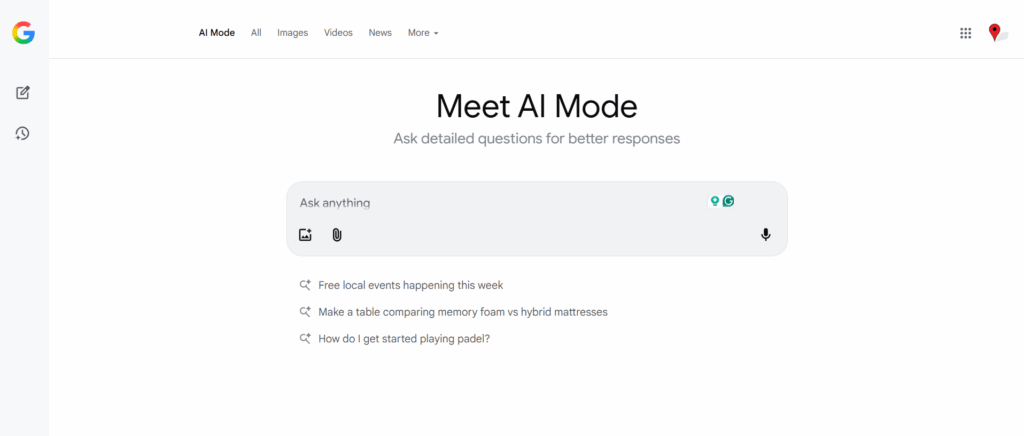
For everyday users, AI Mode transforms search into an intelligent conversation. Instead of searching multiple times and piecing together results, users can now refine queries naturally: “Find me a weekend getaway in Italy under €400” can be followed by “What if I go by train?” or “Show me local food spots.”
Results are visual, summarised, and personalised but less dependent on traditional search rankings. The interface prioritises reasoning over link listing, bringing a new level of speed and relevance.
This shift empowers consumers but also reshapes how they discover brands. Recommendations now appear within AI summaries rather than on static web pages, meaning visibility depends on whether AI systems understand and trust a brand’s content, not just on being indexed.
What Changes for SEO Experts and Digital Marketers
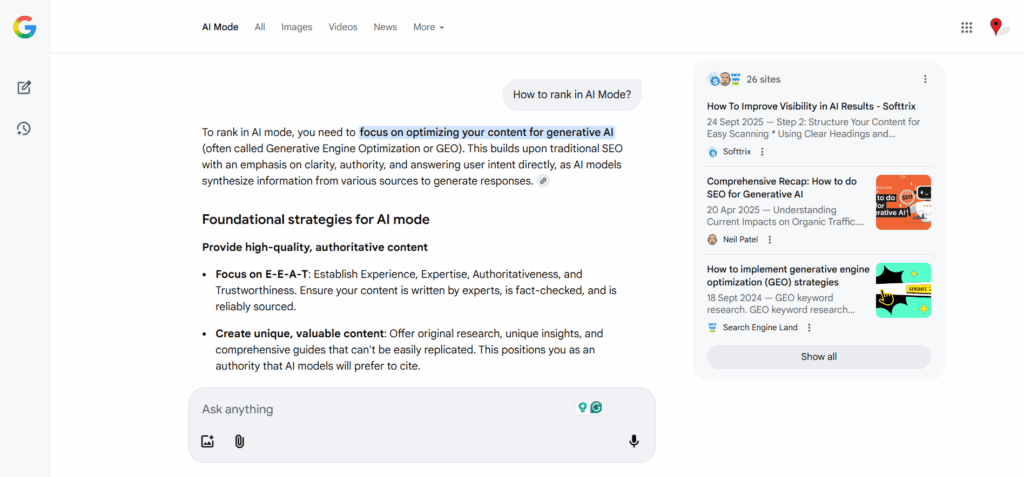
For the SEO industry, AI Mode officially marks the beginning of the post-SEO era, where visibility depends on how AI models interpret your content. Traditional keyword-based optimisation gives way to GEO – Generative Engine Optimisation.
In GEO, the objective is not to rank higher on a search results page, but to be cited or surfaced inside AI-generated answers. To achieve this, content must be:
- Structurally clear – AI must easily identify factual, authoritative information.
- Contextually rich – designed to answer intent-based, multi-layered questions.
- Authentic and trusted – using sources, tone, and clarity that pass Google’s credibility filters.
- Multimodal-friendly – combining text, visuals, and data in ways that AI can parse and repurpose.
SEO experts will now measure success not by “position one” but by AI inclusion, whether their brand’s content becomes part of an AI response.
What Changes for Businesses and Brands
For European companies, AI Mode presents both opportunities and disruptions. Brands that relied on top rankings for visibility must restructure their digital strategies. The winners will be those who:
- Build conversational authority through structured, narrative-driven content.
- Adopt AIO (AI Optimisation) frameworks that are aligned with Google’s AI understanding.
- Integrate product visuals, reviews, and structured data to enable AI Mode to use them contextually.
- Monitor brand mentions inside AI responses, not just traditional analytics.
Businesses must also consider how AI Mode will affect customer acquisition. If Google’s assistant can recommend, compare, and summarise purchase options, the conversion funnel moves directly into AI-driven experiences.
From U.S. Testing to European Rollout
After launching experimental AI Overviews in the U.S. in May 2024, Google expanded to full AI Mode in May 2025. By August, English-speaking markets gained access, and on October 8, 2025, the experience officially reached Europe, introducing multilingual support for over 35 languages, including German, French, Italian, and Romanian.
The European rollout emphasises transparency and compliance with privacy regulations while offering the same reasoning power that made AI Mode successful elsewhere.
Europe’s inclusion accelerates a global transition from Search Engine Optimisation (SEO) to Generative Engine Optimisation (GEO). This shift rewards those who combine creativity, semantic structure, and AI literacy.
At TUYA Digital, we see AI Mode not as a threat to traditional marketing but as a new layer of opportunity. It rewards brands that communicate with precision, authenticity, and depth – values that align with how AI models learn and generate context.
As Adam C, SEO expert at TUYA Digital, notes:
“The arrival of AI Mode in Europe is when SEO officially meets AI. It’s no longer about ranking – it’s about reasoning. GEO will define the future of visibility, relevance, and influence online.”
The New Search Reality
Google AI Mode doesn’t just change how we search; it changes how we think about being found.
From consumers asking more thoughtful questions to marketers crafting more intelligent answers, the European web is now entering its most intelligent phase yet.
The age of conversational, reasoning-driven search has begun, and with it comes a new frontier for digital optimisation: GEO.