
SEO used to be a clean equation: improve rankings, earn more clicks, grow the business. In 2026, that equation is breaking, often first for the most successful sites.
Across competitive verticals, a consistent pattern keeps showing up in Search Console: visibility expands, average position improves, CTR drops, and total clicks decline. This is not a content quality issue in the classic sense. It is a distribution shift. Search is becoming an answer surface, and the click is becoming optional.
The great decoupling: ranking performance doesn’t mean more organic traffic
The defining change of 2026 is decoupling: ranking performance and traffic performance are no longer tightly correlated.
Two forces drive it:
- AI-mediated discovery reduces the need to click.
- Privacy and consent reduce what you can reliably observe and attribute after the click.
If you still evaluate SEO primarily through sessions and CTR trends, you are operating on a model that no longer reflects how discovery works.
A real 28-day snapshot: rankings up, clicks down
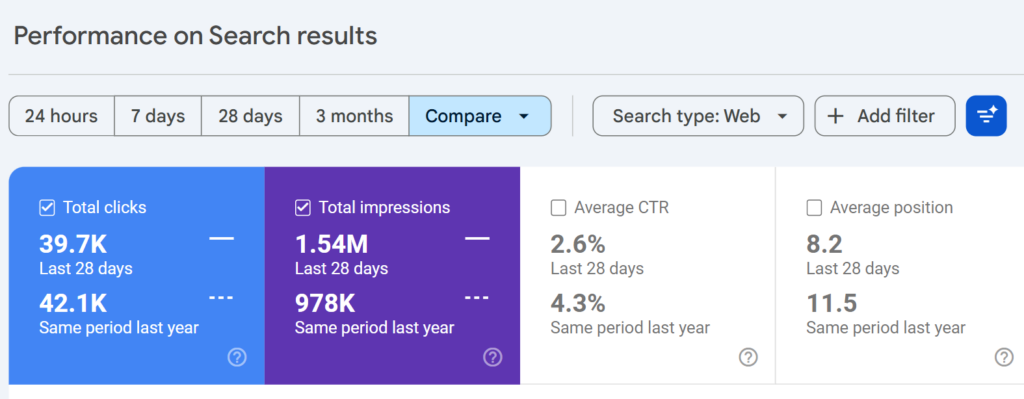
One Search Console comparison from a high-visibility property illustrates the paradox clearly. Over 28 days versus the same period the year before, the site recorded:
- Clicks: 39.7K versus 42.1K (down)
- Impressions: 1.54M versus 978K (up materially)
- CTR: 2.6% versus 4.3% (down sharply)
- Average position: 8.2 versus 11.5 (improved significantly)
This is the 2026 signature: eligibility expanded and rankings improved, yet traffic declined.
What this proves: the interface, not the ranking, is the bottleneck
Historically, moving from an average position around 11.5 to 8.2 should lift traffic. In 2026, it often does not, because AI answer layers and rich SERP modules resolve intent before a visit happens. When the interface satisfies the user, ranking becomes less predictive of clicks.
A fast way to quantify the click gap
If the site had kept the prior CTR (4.3%) on today’s impressions (1.54M), the implied outcome would be roughly 66K clicks. The observed result was 39.7K. That difference is a practical way to estimate the scale of the click tax imposed by AI-first discovery and on-SERP satisfaction.
The AI click tax: where demand goes before the visit
AI layers compress exploration. Users who previously clicked multiple sources now get a synthesised explanation, a shortlist, and next-step recommendations without leaving the results environment.
This creates a structural click reduction that concentrates around:
- informational queries that can be fully answered,
- comparisons and “best of” discovery,
- planning and logistics such as routes, timing, and costs,
- high-consensus topics with many interchangeable sources.
The consequence is uncomfortable but clear: you can win rankings and still lose traffic share because the click is no longer the default action.
The privacy measurement tax: why analytics under-report what still happens
In parallel, measurement has become less complete.
Consent refusal and tracking restrictions do not eliminate demand, but they reduce your ability to observe it through client-side analytics. Operationally, this shows up as fewer measured sessions and users, weaker attribution, and conversion paths that look fragmented, especially on mobile and across devices.
A key nuance for operators: Search Console reports clicks observed on Google, while analytics tools rely on what happens on your site, often under consent constraints. That is why teams can see strong Search Console performance while onsite analytics undercount sessions or mis-attribute outcomes.
The practical takeaway is straightforward: in 2026, SEO reporting must be reconciled across layers, not read from a single dashboard.
Why CTR became a misleading KPI on its own
CTR used to reflect competitiveness. In 2026, CTR increasingly reflects SERP architecture.
When AI answers, maps, and rich modules sit above organic listings, even strong positions can behave like weaker ones in terms of attention. Organic results can still be present, but effectively de-emphasised.
This is why the same site can show better average position, higher impressions, lower CTR, and fewer clicks. Nothing is “wrong” with the ranking system. The interface changed.
The 2026 KPI stack: measure what the interface actually rewards
Clicks still matter, but they cannot be the only KPI. A 2026-ready model uses a layered KPI stack:
Layer 1: Visibility and eligibility
Use Search Console to track:
- impressions by query class and cluster,
- position distribution, not only a single average,
- Click share on SERPs where organic clicks still exist.
Layer 2: On-site yield
When volume is harder to earn, quality matters more:
- conversion rate and revenue per session,
- micro-conversions aligned with intent completion, such as subscribe, contact, save, or plan,
- journey efficiency that moves users to action quickly.
Layer 3: Influence beyond the click
Because not every discovery becomes a visit, measure:
- brand query growth and navigational demand,
- returning users and direct re-engagement,
- citations and mentions across AI surfaces and secondary ecosystems.
Layer 4: Reality checks
Validate what analytics cannot fully see:
- server or CDN trendlines versus tag-based sessions,
- backend events such as orders, leads, or CRM entries,
- reconciliation between reported clicks and observed landings.
This prevents optimising based on partial visibility.
The GEO pivot: how to win when the click is optional
In 2026, the goal is not only ranking. It is selection and reuse: the source AI systems draw from, cite, or paraphrase, and the results users choose when they click.
Engineer pages for extraction and accuracy
AI systems prefer content that is clearly scoped, structured into answerable blocks, specific in constraints and steps, and unambiguous in definitions and recommendations. The objective is simple: make it easy for an AI system to lift the correct answer without risk.
Treat titles and snippets like decision copy
When clicks are scarce, the remaining clicks go to results that communicate usefulness instantly. Titles and descriptions should signal a concrete promise, real specificity, trust cues, and a clear next step.
Shift part of SEO from capture to creation
The most resilient traffic in an AI-first environment is traffic that does not depend on generic SERPs. That includes branded searches, repeat usage, and owned channels such as email and community. This is not a branding nice-to-have. It is a hedge against a shrinking click opportunity.
What winning looks like in 2026
A modern success profile is not “rankings up, traffic up.” It looks like:
- expanding impressions while protecting high-intent clusters,
- stabilising click share where clicks still exist,
- improving conversion efficiency per visit,
- growing brand demand and repeat engagement,
- proving impact with a reconciled, privacy-aware measurement stack.
The takeaway
The pattern in the snapshot, impressions up, position up, CTR down, clicks down, is not a temporary anomaly. It is the 2026 reality of AI-mediated search and privacy-constrained measurement.
SEO is not disappearing. The click model is. The strategic response is GEO: optimise for selection, citation, and downstream outcomes, and report performance with metrics that reflect how discovery actually works now.